|
Rabbi Moses Cordovero, Mystic Sage of Kabbalah© Copyright 2006 by Timothy Conway; additions made in August, 2011Rabbi Moshe or Moses Cordovero (1522-70) stands out as a giant among the great Jewish mystical philosopher-saints, clearly articulating a doctrine of Divine panentheism, God in all, all in God... careful to note that while God (G-d, in pious use) is manifesting all phenomena or creatures, these phenomena are not themselves God in toto. God / G-d is the ultra-intelligent, ultra-benevolent Source, Substance and Destiny of all. Moses grew up and lived in Safed, a small Galilean city in northern Palestine (Israel), where a major renaissance of Jewish kabbalah mysticism would occur through his and others’ efforts. Moses, also known by the acronym based on his title and name, the RaMaK, was one of the most prolific and original figures in kabbalah history, a major influence during his era. Among other things, he was the first to fully integrate the earlier differing schools of Kabbalist interpretation, and he integrates a high-flown mystical theology with pragmatic ethical-devotional-spiritual practice. Rabbi Moses was definitely more interested in intuitive, metaphysical wisdom and moral leadership, eschewing the sensational brand of Kabbalah focused on magical talismans and miracles, practices too rampant then and now. He certainly deserves to be as well known today in Jewish mystical thought as those two towering figures of Jewish mystical contemplation and charisma, Isaac Luria, ha-Ari (who either met the RaMaK or was greatly inspired by him) and the eminent founder of 18th century Hasidism, Rabbi Israel the Ba'al Shem Tov (Master of the Divine Name). The Cordovero family likely came as exiles from Cordoba, leaving Spain after the terrible 1492 edict by King Ferdinand and Queen Isabella expelling all Jews unless they converted to Christianity. Young Moses ben Jacob Cordovero learned rabbinic law (halakhah) and something of kabbalah Jewish mysticism under the great legal authority and kabbalist Joseph Caro (1488-1575). At age 20, allegedly at the behest of a heavenly voice, Moses began to more deeply study Kabbalah, the esoteric heart of the Biblical Torah, with his brother-in-law Shlomo (Solomon) HaLevi Alkabetz. A few years later, while writing the introduction to his own first kabbalist work, Moses said that until he began learning Kabbalah, he was as if asleep and pursuing idle thoughts. Scholar Lawrence Fine, in Safed Spirituality: Rules of Mystical Piety, The Beginning of Wisdom (NY: Paulist Press, 1984), comments on the teacher-student relationship between Shlomo and Moses: “It appears that a reversal of roles took place and pupil became teacher. Cordovero [who for a while served as head of the yeshiva for the Portuguese community of Safed] quickly succeeded in becoming the principal master of esoteric studies in [all of] Safad. His disciples included most of the great mystics of that city,” including the luminary Rabbis Hayyim (Chaim) Vital (1542-1620), Elijah (Eliyahu) de Vidas and Abraham Galanti. Supporting his wife (we don't know her name) and his son Gedaliel by working as a pearl merchant, Rabbi Moshe Cordovero spent the rest of his time drafting, systematizing and teaching a form of kabbalah that combined elements of the Zohar (by Moses de Leon, 13th century), other kabbalist works and teachers, and traditional medieval Jewish and Arab philosophy. Cordovero’s first major written work, Pardes Rimmonim (Pomegranate Orchard), completed when he was only 27, was an encyclopedic presentation of the teachings of the Zohar and all kabbalist thought up to that time. It became one of the most renowned texts of kabbalah and established him as a spiritual leader in Safed. While writing the Pardes, the RaMaK also began a 16-volume Zohar commentary, Or Yaqar (Precious Light), the first comprehensive running commentary on this seminal kabbalah text. He worked on the Or Yaqar throughout his life. Rabbi Moses authored another systematic though more abstract work, Elimah Rabbati, and several further treatises, like the Sefer Gerushin, a short, intimate work of Kabbalist commentary on 99 Divine Names, also revealing his and colleagues' devotionalism, asceticism and piety in their spiritual community. Several Jewish-prayer commentary books were also composed by the Rabbi. And his little treatise Tomer Devorah (Deborah’s Palm Tree) “was the most influential Jewish mystical ethical work for the following centuries” (Geoffrey Wigoder). A deeply motivational text integrating an impeccable morality with a higher, refined sense of kabbalist esotericism, this book outlined the attributes of Divine Crown (Keter) and the other nine Sefirot or Divine emanations, and shows how these can be emulated by human beings. Just as G-d is exceedingly tolerant, patient, forgiving, kind and merciful toward us, so should we be toward others, especially the most terrible sinners and those who harm us. “His existing writings suggest many other compositions which he either intended to write or had actually written, but were lost.” (Wikipedia) Even today, some of his work is only in manuscript form, not yet published, though progress is being made. For instance, in 2005 in Jerusalem a 22-volume work was finally published out of his 16-volume Or Yaqar. In 1550, the year after completing the Pardes, the 28-year-old Moses Cordovero had opened a kabbalah academy in Safed, which he led until his passing 20 years later. One tradition says that, for a short time in 1570, right before he died on June 25th of that year, he instructed the younger, brilliant, innovative kabbalist and miracle-worker who had just settled in Safed, Isaac Luria (acronym: ha-Ari; 1534-72). Another tradition holds that the Ari only arrived in Safed on the very day of Moses' funeral, and, joining in the funeral procession, he saw a glorious pillar of fiery light following the RaMaK's mortal remains. At the funeral, the revered rebbe, Joseph Caro, Moses' old halakhah teacher, exclaimed, “Here lies the Ark of the Torah.” Isaac Luria died of the plague in his 38th year just two years afterward in 1572. Though the secret Lurianic system of kabbalah spread by the latter’s disciples (especially Hayyim Vital, a disciple of the RaMaK until the latter's death) eventually came to eclipse Moses Cordovero’s version in popularity, Cordovero’s clear-cut, balanced teachings make for one of the finest expressions of kabbalah ever to appear in print. His panentheist theology-philosophy upholds G-d’s utter transcendence beyond all beings along with G-d’s complete immanence within all beings. Meanwhile, his cogent spiritual insight wisely balances an enlightened nondual view with pure-hearted behavior. Thus can the sagely, saintly Rabbi Moses Cordovero be regarded as one of the most sublime Jewish mystics of all time. A contributor to a Wikipedia article on Cordovero has pertinently observed: “The two schools of Cordoveran and Lurianic Kabbalah give two alternative accounts and synthesis of the complete theology of Kabbalah until then, based on their interpretation of the Zohar. After the public dissemination of the Zohar in Medieval times, various attempts were made to give a complete intellectual system of theology to its different schools and interpretations. Influenced by the earlier rational success of Jewish philosophy, especially the work of Maimonides, in producing a systematic intellectual articulation of Judaism, the RaMaK achieved the first accepted systemisation of Kabbalah, based on its rational categorisation and study. Subsequent followers of the Ari [Isaac Luria] saw their teachings as harmonious with, and a deeper interpretation of the Zohar and the RaMaK's system, but the new system of Isaac Luria revealed completely new doctrines, as well as new descriptions of the earlier ideas of Kabbalah. In time, Lurianic Kabbalah emerged as the dominant system; however, the works of the RaMaK are still highly esteemed and widely studied, as well.” An article on Rabbi Moses for JewishEncyclopedia.com, "REMAḲ (MOSES BEN JACOB CORDOVERO)," by Joseph Jacobs and Isaac Broyde, well illumines the subtle panentheism of the RaMaK: Cordovero endeavored to elucidate all the tenets of the Cabala [Kabbalah], such as the doctrines of the sefirot, emanation, the divine names, the import and significance of the alphabet, etc. Quite original is Cordovero's conception of the Deity set forth by him in his Shi'ur Ḳomah. It is surprisingly identical [at least in a few aspects] with that taught later by Spinoza [1632-77] and there can be no doubt that the Dutch philosopher [of Sephardic Jewish descent, a leading ethicist and a pioneer of the European Enlightenment] alluded to Cordovero when, in answer to the question addressed to him by his friend Henry Oldenburg on the origin of his theory, he referred to an old Jewish philosopher (Epistola, pp. 21-2). [NOTE from Timothy: Baruch Spinoza's more supra-personal conception of Deity, and his panentheist view of the Infinite Divine as being both transcendent and immanent, the true Reality or Substance of the world as That which "stands under" all phenomena, attributes and modes-- these aspects of the Divine were certainly taught in the prior century by Rabbi Moses Cordovero, just as these panentheist principles were taught by other sages going back most anciently to the Vedanta Upanishads. However, unlike Spinoza, Cordovero's sense of God also obviously includes the Personal within the Supra-Personal, and Divine mercy and caring within the transcendence and singularity of God. Rabbi Moses is also more of a moralist—albeit an all-forgiving one— and less of a determinist than Spinoza. The JewishEncyclopedia.com article continues:] In describing the relation of God to His creatures Cordovero expresses himself in the following terms (Shi'ur Ḳomah, chapter xxii): "And the Holy One—blessed be He!—shines in the ten sefirot of the world of emanation, in the ten sefirot of the world of creation, and in the ten heavenly spheres. In investigating this subject the reader will find: that we all proceed from Him, and are comprised in Him; that our life is interwoven with His; that He is the existence of all beings; that the inferior beings, such as vegetables and animals, which serve us as nourishment, are not outside of Him; in short, he will discover that all is one revolving wheel, which ascends and descends—all is one, and nothing is separated from Him." But what relation can there be between the infinite, eternal, and necessary being and the corporeal, compounded world? Then, again, if nothing exists outside of God, how is the existence of the universe to be explained? Its creation at a certain definite time presupposes a change of mind on the part of God; and this is inadmissible, for it is not possible to ascribe to Him any change or alteration. These problems Cordovero endeavors to solve in the Pardes Rimmonim. The question how could the finite and corporeal proceed from God, who is infinite and incorporeal, is explained by him by the doctrine of concentration of the divine light, through which the finite, which has no real existence of itself, appeared as existent. From the concentration of the divine light proceeded by a successive emanation the ten sefirot or the dynamic tools, through which all change takes place (Sha'ar 'Aẓamot we-Kelim, iv). Great development is given in the Pardes to the question of the divine attributes. Cordovero not only adopts the Aristotelian principle that in God thinker, thinking, and the object thought of are absolutely united, but he posits an essential difference between God's mode of thinking and that of man.(Pardes Rimmonim, 55a) "God's knowledge," says Cordovero, "is different from that of the creature, since in the case of the latter knowledge and the thing known are distinct, thus leading to subjects which are again separate from him. This is described by the three expressions—cogitation, the cogitator, and the subject of cogitation. Now, the Creator is Himself Knowledge, the Knower, and the object known. His knowledge does not consist in the fact that He directs His thoughts to things without Him, since in comprehending and knowing Himself He comprehends and knows everything that exists. There is nothing which is not united to Him, and which He does not find in His own Substance. He is the archetype of all existing things, and all things are in Him in their purest and most perfect form; so that the perfection of the creatures consists in the support whereby they are united to the primary source of His existence, and they sink down and fall from that perfect and lofty position in proportion to their separation from Him." (http://www.jewishencyclopedia.com/view.jsp?artid=208&letter=R) It was Rabbi Moses' son Gedaliah (1562-1625) who, years after his father's death in 1570, initiated the publishing of some of the RaMaK's books in Venice, Italy, around 1584-7. Gedaliah was buried in Jerusalem, where he had spent most of his adult life after returning from Venice. Meanwhile, during the late 1500s and early 1600s the published works of Rabbi Moses Cordovero--only a fraction of his total output--began to see editions appearing in the towns of central-eastern Europe, such as Cracow, Lublin and Prague. Much of this likely had to do with the ministry of Rabbi Moshe's disciple Rabbi Menachem Azariah DeFano (Maharam MiPano), author of many works and one of Europe's leading Kabbalists, often teaching from his master's book Pardes Rimmonim and others. Thus were sown important seeds of Moses Cordovero's mystic-moral system for the later rise of the great Hasidic mystical kabbalist movement founded in that region of Europe by the illustrious Ba'al Shem Tov, Rabbi Israel ben Eliezer (1698-1760), from the late 1720s onward.... Teachings of Rabbi Moses Cordovero: [The first several selections here are from Rabbi Moses' philosophical-theological works, as translated by Daniel Matt (Ed. & Tr.) in his book, The Essential Kabbalah: The Heart of Jewish Mysticism, HarperSF, 1995, pp. 22, 24, 28, 27):] An impoverished person thinks that God is an old man with white hair, sitting on a wondrous throne…. Imagining this and other fantasies, the fool corporealizes God. He falls into one of the traps that destroy faith. His awe of God is limited by his imagination. But if you are enlightened, you know God’s oneness [“…Adonai ehod,” as posited by the foundational Jewish prayer, the Sh’ma]. You know that the Divine is devoid of bodily categories—these can never be applied to God…. No letter, vowel or image can be applied to … Ein Sof, whom we cannot depict, of whom we cannot speak, of whom we cannot posit either judgment or compassion, excitement or anger, change or limit, sleep or motion, or any quality whatsoever, either prior to the emanation or now. (Or Ne'erav [Pleasant Light]) The essence of divinity is found in every single thing—nothing but it exists. Since it causes every thing to be, no thing can live by anything else. It enlivens them; its existence exists in each existent. Don’t attribute duality to God. Let God be solely God. If you suppose that Ein Sof [Boundless, Infinite (Divine)] emanates until a certain point, and that from that point on is outside of it, you have dualized. God forbid! Realize, rather, that Ein Sof exists in each existent. Do not say, “This is a stone and not God.” God forbid! Rather, all existence is God, and the stone is a thing pervaded by divinity. (Shi'ur Qomah, 206b [this short text is part of the 16-vol. Or Yaqar]) Before anything emanated, there was only Ein Sof. Ein Sof was all that existed. Similarly, after it brought into being that which exists, there is nothing but it. You cannot find anything that exists apart from it. There is nothing that is not pervaded by the power of divinity. If there were, Ein Sof would be limited, subject to duality. God forbid! Rather, God is everything that exists, though everything that exists is not God. It is present in everything, and everything comes into being from it. Nothing is devoid of its divinity. Everything is within it; it is within everything and outside of everything. There is nothing but it. (Elimah Rabbati, 24d-25a) We must conclude that nothing is outside of God. This applies not only to the sefirot [archetypal Divine emanations] but to everything that exists, large and small—they exist solely through the divine energy that flows to them and clothes itself in them…. This is the secret meaning of the verse: “You enliven everything.” So divinity flows and inheres in each thing that exists. This is the secret meaning of the verse: “God’s presence fills the entire world.” Contemplating this, you are humbled, your thoughts purified. (Or Yaqar 15:203a) Each of us emerges from Ein Sof and is included in it. We live through its dissemination. It is the perpetuation of existence…. This process is like a revolving wheel, first descending then ascending. It is all one and the same, nothing is separate from it. Though life branches out further and further, everything is joined to Ein Sof, included and abiding in it. Delve into this. Flashes of intuition will come and go, and you will discover a secret here. If you are deserving, you will understand the mystery of God on your own. (Shi'ur Qomah, 16d-17a)
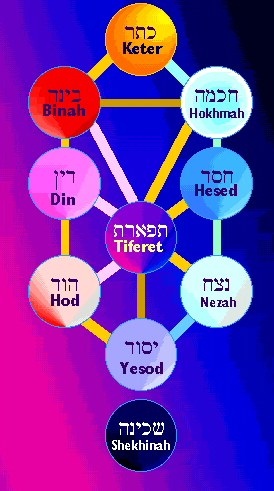
(The Ten Sefirot: Keter/Crown [Center, top], Hokhmah/Wisdom [R], Binah/Understanding [L], Hesed/Grace [R], Din/Strength [L], Tiferet/Mercy, Nezah/Endurance [R], Hod/Majesty [L], Yesod/Foundation [Center, near bottom], Shekhinah/Glory [Center, bottom])
[Rabbi Moses Cordovero’s little book Tomer Devorah (Palm-Tree of Deborah), “the most influential Jewish mystical ethical work for the following centuries,” is a moral treatise devoted to the Imitation of God according to the attributes of the Divine emanations or sefirot. Here below are excerpts, from a translation by Louis Jacobs, Moses Cordovero: The Palm Tree of Deborah, London: Vallentine, Mitchell, 1960; reprint NY: Sepher-Hermon Press, 1974. Note: there exists a newer English translation, along with the Hebrew text and copious notes, by Rabbi Moshe Miller, The Palm Tree of Devorah, Southfield, MI: Targum Press, 1993].
It is proper for man to imitate his Creator, resembling Him in both likeness and image [Genesis 1:26] according to the secret of the Supernal Form [Supernal Human]. Because the chief Supernal image and likeness is in deeds, a human resemblance merely in bodily appearance and not in deeds debases that Form…. It is proper for man to imitate the acts of the Supernal Crown [Keter, highest of the ten sefirot Divine emanations], which are the thirteen highest attributes of mercy, hinted at in the [Biblical] verses: Who is a God like unto Thee, that beareth iniquity / And passeth by the transgression of the remnant of His heritage? / He retaineth not His anger for ever, / Because he delighteth in mercy. / He will again have compassion upon us; / He will subdue our iniquities: / And Thou wilt cast all their sins into the depths of the sea. / Thou wilt show faithfulness to Jacob, mercy to Abraham / As Thou has sworn unto our fathers from the days of old. (Micah 7:18-20) Hence it is proper that these thirteen attributes, which we shall now expound, be found in man. (Chapter 1) There is nothing hidden from His providence. Furthermore, there is no moment when man is not nourished and does not exist by virtue of the divine power that flows down upon him. It follows that no man ever sins against God without the divine affluence [vitality] pouring into him at that very moment, enabling him to exist and to move his limbs. Despite the fact that he uses it [the vital power] for sin, that power is not withheld from him in any way. But the Holy One, Blessed is He, bears this insult and continues to empower him to move his limbs even though he uses the power in that moment for sin and perversity offending the Holy One, Blessed is He, who, nonetheless, suffer it…. This is why the ministering angels refer to the Holy One, Blessed is He, as 'the patient King.' And this is the meaning of the prophet's words: "Who is a God unto Thee?" He means: 'Thou, the good and merciful, art God, with the power to avenge and claim Thy debt, yet Thou art patient and bears insult until man repents.' Behold this is a virtue man should make his own, namely, to be patient and allow himself to be insulted even to this extent and yet not refuse to bestow of his goodness to the recipients. (1:1) A man should learn the degree of patience in bearing his neighbor's yoke and the evils done by his neighbor even when those evils still exist. So that even when his neighbor offends he bears with him until the wrong is righted or until it vanishes of its own accord and so forth. (1:2) When man sins the Holy One, Blessed is He, Himself (and not by means of a deputy) rights the sin and washes its stain away. From this one can learn the depth of shame in sinning, for the King is obliged to cleanse the filthy garments. (1:3) All Israel are related one to the other, for their souls are united and in each soul there is a portion of all the others…. Since all Israelites are related to each other it is only right that a man desire his neighbor's well-being, that he eye benevolently the good fortune of his neighbor and that his neighbor's honor be as dear to him as his own; for he and his neighbor are one. This is why we are commanded to love our neighbor as our self [Lev. 19:18]. It is proper that a man desire the well-being of his neighbor and that he speak no evil of him nor desire that evil befall him. Just as the Holy One, Blessed is He, desires neither our disgrace nor our suffering because we are His relatives, so too, a man should not desire to witness evil befalling his neighbor nor see his neighbor suffer or disgraced. And these things should cause him the same pain as if he were the victim. The same applies to his neighbor's good fortune. (1:4) “He retains not His anger forever”: This is yet another divine quality, that even when man persists in sinning the Holy One, Blessed is He, dos not persist in retaining His anger and even when He does it is not for ever but He allows His anger to abate even when man does not repent…. He allows His anger to lose its force and though the sin still lingers He does not punish but ever longs, compassionately, for man's repentance…. This is the quality which a man should make his own in dealings with his neighbor or his own children.… This applies even where such anger is permissible: for instance, … the man who sees his neighbor commit a sin but when there is no other person present so that he cannot be testified against in a Court of Law. In this case it is permitted to hate the sinner for the offence he has committed but, nonetheless, the Torah says: 'AZOBH TA'AZOBH 'IMMO [Exodus 23:5] ('Thou shalt surely help him'), explained by the Rabbis to mean: 'Thou shalt leave aside that which is in thy heart.' It is a religious duty to encourage him lovingly, and, perhaps, this way of dealing with him will succeed. (1:5) The Holy One, Blessed is He, … has mercy upon Israel, for He delights in mercy. Even when they are guilty He has mercy upon them if they are kind to one another…. It is fitting, therefore, that man make this quality his own. Even when he is offended or provoked, if the offender has his good points in that he is kind to others or he possesses some other good quality this should be sufficient to soothe his anger so that his heart is pleased with him and he delights in the kindness he does. And he should say: 'It is enough for me that he possesses this good quality.' How much more so with regard to one's wife… So he should say with regard to all men: 'It is enough for me that he has shown me or another man kindness or that he possesses this particular good quality.' And he should delight in mercy. (1:6) The Holy One, Blessed is He, does not behave as a human being behaves. When the latter has been provoked he cannot bring himself to love as formerly the one who offended him, even when he has been appeased. But in God's sight the repentant sinner has a higher status than the man who has never sinned…. This is how man should behave towards his neighbor. He should not feed hatred from his former anger but when he sees that his neighbor wants to love him he should show him a greater degree of kindness and love than formerly. He should say: 'Behold he is to be compared to the penitents in whose place the perfectly righteous cannot stand.' And he should encourage him to a far greater degree than those who are perfectly righteous, namely, those who have not offended him. (1:7) As it is written: 'Evil shall not sojourn with Thee' (Psalm 5:5)—evil cannot dwell in Thy dwelling place. If this is so then sin does not enter into the inmost Presence [but good does enter]…. [So also, a man must be careful not] to subdue the good his neighbor had done and to remember the evil he has done. On the contrary, he should subdue evil, forget it and reject it so that evil does not dwell within him. But the good his neighbor had done should always be arraigned before him and he should remember this good so that it prevails over all the deeds his neighbor has done. And he should not deduct in his heart, saying: "If he has done good to me he has also behaved badly to me,' so that the good is forgotten. He should not do this, but with regard to the evil his neighbor has done to him he should allow himself to be appeased in every possible way. But the good should never be removed from his sight and he should hide himself from the bad as far as he possibly can, just as the Holy One, Blessed is He, subdues iniquity, as I have explained. (1:8) When Israel is punished the Holy One, Blessed is He, repents for what has happened before and He makes demands on behalf of their shame.… This quality a man should make his own. Even if his neighbor is crushed through suffering as a result of his sins he should not be hated, for 'after he has been disgraced, he is as thy brother.' He should welcome those who suffer and are punished and have mercy upon them. On the contrary, he should save them from their enemies and should not say: 'His sufferings are the result of his sins' but he should have compassion upon him according to this quality. (1:9) A man should behave in truth and uprightness to his neighbor, without perverting justice. He should have compassion on his neighbor in truth just as the Holy One, Blessed is He, has compassion on those of His creatures who are no more than average, to perfect them in accordance with the quality of truth. (1:10) …The ones who go beyond the letter of the law as did Abraham, our father. The Holy One, Blessed is He, too, behaves towards them beyond the letter of the law. He does not invoke the power of justice, not does He behave towards them in a strict uprightness alone, but He goes beyond the letter of the law, as they do. (1:11) There are people who are unworthy and yet the Holy One, Blessed is He, has mercy upon them…. So, too, should a man behave. Even when he meets with the wicked he should not behave cruelly towards them nor insult them but have mercy upon them saying: 'Even so, they are the children of Abraham, Isaac and Jacob. If they are not worthy their fathers were worthy and upright and he who brings disgrace upon the children brings disgrace upon the fathers and I have no wish that the fathers be despised through me.' And he should conceal their shame and improve them as much as is in his power. (1:12) When, for instance, the merit of the fathers has come to an end and they are unworthy in themselves what does He do? It is written: 'I remember for thee the affection of thy youth' The Holy One, Blessed is He, actually recalls all the good deeds they have done from the day of their birth and all the good qualities with which the Holy One, Blessed is He, controls the world. From all these He creates a special property with which to show mercy to them.… So, too, should a man behave. Even when he cannot discover any plea such as those mentioned he should still say: 'Behold there was a time when they had not sinned. And in that time or in former days they were worthy.' And he should recall the good they have done in their youth…. In this way no man will be found an unworthy recipient of goodness nor unworthy to be prayed for and to have mercy shown to him. (1:13) Until now, we have expounded the thirteen qualities by which man resembles his Creator. These are the qualities of higher mercy and their special property is that just as man conducts himself here below so will he be worthy of opening that higher quality from above. As he behaves, so will be the affluence from above and he will cause that quality to shine upon earth. (1) For man to resemble his Creator according to the secret of the Supernal Crown he must possess, too, many of the chief qualities of the divine providence. 1) The quality of humility includes all qualities, for it belongs to the Crown, which is the highest attribute. It does not raise nor exalt itself upwards; on the contrary, it descends to look downwards at all times…. Behold, there is none so patient and so humble as our God in His quality of Crown. For there is perfect mercy before which there can enter no flaw, sin, judgment nor any other quality to prevent it providing and flowing with goodness at all times. So, too, should man behave, that no cause whatsoever prevent him doing good to others and any sin or the misdeeds of unworthy persons be barred entrance in order to prevent him doing good to all who need it at all times and in every moment…. [As God is always] showing mercy to them all, so man should be good to all creatures, despising none, that even the most insignificant assumes importance in his eyes and he be concerned with it. And he should do good to all in need of his goodness. 2) His thoughts should resemble the thoughts of the Crown. Just as wisdom never ceases from thinking good thoughts, not allowing evil to enter, for it is perfect mercy and there is no judgment and nothing at all harsh there, so, too, man's mind should be free from every ugly thing.… Man should not turn his mind to any thoughts apart from those of Torah and the contemplation of God's majesty and goodness and the way to do good and so forth. In short: nothing strange nor negative should be present in his thoughts. 3) He should be pleased to accept everyone. Even when he meets with provokers he should appease them and quiet them with good will…. [Man] should appease those whose anger prevails and he should lead them on in good will, drawing on great wisdom to weaken their anger that it does not overstep its boundaries and cause harm, God forbid. He should behave as the Supernal Will, which proceeds from the wonderful wisdom … which accepts all creatures. He should derive, too, the power to be pleasant to all creatures. 4) His ears [should] be ever open to hear good but an evil or ugly report be barred from entering them, according to the secret of Supernal Listening; for no cry of judgment nor the flaw of evil talk is allowed entry there. So he, too, should listen only to good and useful things; and other things which cause anger to prevail should receive no hearing whatsoever…. 5) His eyes should not gaze at any ugly thing. They should, however, be ever open to notice and show mercy to sufferers as much as possible. He should in no way close his eyes when he sees the sufferings of the poor but give as much thought to their predicament as lies in his power and awaken the pity of Heaven and of humans upon them. He should be far removed from noticing evil, just as the Supernal Eye is ever open to look immediately at the good. 6) There should be no anger in him whatsoever. But there should be at all times vitality, good will and great patience even to the unworthy. He should desire at all times to fulfill everyone's desires, to grant every request, and to revive every sufferer…. He should not be angry with those who offend him but he should be constantly willing to be appeased and desire to do kindness so as to please all. 7) His face should shine constantly, so to welcome all men with good countenance. For with regard to the Supernal Crown it is said: 'In the light of the king's countenance is life.' Neither redness nor any judgment enters there. So, too, the light of his face find there only joy and good humor; and no cause should in any way disturb him in this. (2) Behold, these are eight good qualities, all of them under the banner of humility, all of which are in the higher worlds in the Crown among the Supernal Limbs…. The chief quality he should make his own is humility, for this is the key to them all for it is the chief of them all, the first aspect of the Crown, under which all are contained. Behold, humility chiefly means that man finds no worth in himself but values himself as naught…. when he strives constantly to acquire this quality all other good qualities will follow in its wake. For the first quality of Crown is that it considers itself as naught before the One from Whom it emanates. So, too, a man should consider himself as actually nothing and his non-existence far better than his existence. As a result of this he will behave towards those who offend him as if they were right and he the wrongdoer. And this will be the cause of acquiring the good qualities (2) Now I have found a cure by which a man can accustom himself to these things little by little so that he may be cured of the disease of pride and enter the gates of humility. This ointment is made up of three balms. The first is that he accustom himself to flee honor as much as possible…. The second is that he should train his thoughts to appraise his own worthiness, saying: 'What does it matter if people do not know how despicable I am, do I not know myself that I am despicable in this and that thing?'… The third is that he constantly think on his sins, desiring purity and rebuke and suffering. And he should say: 'What are the best sufferings in the world, which will not deter me from God's service?' There are none better than that he be insulted, despised and railed against. For these will not withhold his strength from him and he will not be sick. Nor will his food and clothing be withheld nor his life nor the lives of his sons. If so he should actually desire them saying: 'Why should I fast and afflict by myself with sackcloth and flagellation which weaken my strength for God's service that I bring them upon myself? It is far better that I suffer men's contempt and insult that my strength does not depart and is not weakened.' In this way when insults are meted out to him he will rejoice in them and, on the contrary, desire them. From these three ingredients he should compound and ointment for the heart and accustom himself to this all his days. I have further found a good medicine…. This is that man should train himself to do two things: first, to honor all creatures, in whom he recognises the exalted nature of the Creator…. The second is to bring the love of his fellow-men into his heart, even loving the wicked as if they were his brothers and more so until the love of his fellow-men becomes firmly fixed in his heart…. How can he love them? By recalling in his thoughts the good qualities they possess, by covering their defects and refusing to look at their faults and only at their good qualities. (2) Wisdom [Hokhmah, Chochma] is the father of all created things. As it is written: 'How manifold are Thy works, O Lord! In wisdom Thou has made all of them.' They live and exist from that source. So, man, too, should be a father to all the creatures of the Holy One…. He should not tire nor hide himself nor become weary in leading each one according to his needs. These are the qualities of Wisdom, of the father merciful to his children…. Man's pity should be extended to all the works of the Blessed One just as the Supernal Wisdom despises no created thing for they are all created from that source…. He should despise no created thing, for they all were created in Wisdom. He should not uproot anything that grows, unless it is necessary, nor kill any living thing unless it is necessary. And [when necessary,] he should choose a good death for them, with a knife that has been carefully examined, [so as] to have pity on all things and not to hurt them…, unless it be to elevate them higher and higher, from plant to animal and from animal to human. (3) How shall a man train himself to acquire the quality of Understanding [Binah]? It is to be acquired by returning in perfect repentance…. He who thinks of repentance all his days causes the Supernal Understanding to illumine all his days so that all his days are in repentance, that is to be included in Understanding which is Repentance, and the days of his life will be crowned according to the secret of the Supernal Repentance…. Man roots himself in the secret of evil and renders it sweet and brings it into the good. Therefore, man purifies the evil inclination and brings it into the good so that it becomes rooted above in the hold. (4) How shall a man train himself to acquire the quality of Loving-kindness [Grace/Hesed]? The main way in which man can enter into the secret of Loving-kindness is to love God with perfect love so as not to forsake His service for any reason whatsoever for nothing has any value at all for him compared with the Blessed One's love…. This love should be firmly fixed in his heart whether he receives good at the hands of the Holy One, Blessed is He, or whether he receives sufferings and rebukes. These latter, too, he should look upon as tokens of God's love. … This was the quality of Nahum of Gamzu who used to say: 'This, too, is for good.' … (5:1) [On behalf of Loving-kindness, a man must also take proper care of babies and children,] visit the sick and heal them, … give charity to the poor, … welcome guests, … attend to the dead, … bring the wife under the marriage canopy, … make peace with the wife/neighbor.… All similarly peaceful acts are acts of benevolence on behalf of the Upper Worlds. (5:2-3) How should a man train himself to acquire the quality of Beauty [Tiferet]? There is no doubt that the quality of Beauty is to be found in the study of the Torah. However, great care must be taken that man does not exalt himself in pride because of the words of the Torah, in order that he does not cause great evil…. But he who abases himself over words of Torah causes Beauty to descend and lower itself to pour out its influence upon those beneath. (7) How should a man train himself to acquire the qualities of Endurance, Majesty, and Foundation [Nezah, Hod, Yesod]?… first of all it is necessary to help students of the Torah and to support them either with money or deeds, so as to provide them with the things they require for their work, to prepare their food, and to fulfill all their desires, so that they do not cease in the study of the Torah…. he who studies the Torah must be prepared to learn from all men, as it is written: 'From all my teachers I have gotten understanding.' For the Torah cannot be adequately studied from one teacher alone. As a result of becoming a pupil of all he has the merit of becoming a chariot to Endurance and Majesty…. However, how should man train himself to acquire the quality of Foundation? A man must be on his guard against the kind of speech which brings to thoughts of sin, so that he should not be visited by a seminal emission…. (8) How should a man train himself to acquire the quality of Sovereignty? First and foremost he should not be proud in his heart because of all that is his, but he should behave constantly like a beggar, standing before his Creator as a poor man begging and offering supplication…. A further most excellent quality of Sovereignty from the gate of divine service as a whole is to fear the Lord, the honored and the awful…. Furthermore, a man must be very careful to behave so that the Shekhinah [Divine Glory] cleaves always to him and never departs.… And the Shekhinah cannot come to him unless he resembles the Supernal Reality. (9) He should then make a Tikkun [healing reparation] for the [Divinely exiled, immanent] Shekhinah by studying the Torah… and he will be bound to Her and She to him. The form of his soul will ascend to the Garden of Eden with the Shekhinah who enters there to delight with the righteous and with him in their company, for they all hearken to his voice. So that he actually journeys with Her from death and sleep to the secret of Supernal Life and he is bound there, according to the secret of the Garden of Eden, and the light of Beauty which shines upon the righteous in the Garden of Eden begins to shine upon him. (10) --------------------- (NOTE: Rabbi Moses Cordovero is not to be confused with the scholarly, philanthropic physician named Moses Cordovero, who lived a long life at Livorno, Tuscany in the 17th century.) |
